

52 Cards In A Row
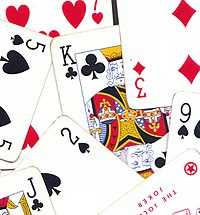
Cards from a standard, English or Anglo-American pattern, deck
The standard 52-carte deck of French-suited playing cards is the nearly common pack of playing cards used today.[a] In English-speaking countries information technology is the only traditional pack[b] used for playing cards; in many countries of the earth, nonetheless, it is used alongside other traditional, often older, standard packs with different adapt systems such as those with German-, Italian-, Spanish- or Swiss suits. The well-nigh mutual pattern of French-suited cards worldwide and the only ane commonly available in Britain and the United States is the English blueprint pack. The second most common is the Belgian-Genoese design, designed in France, but whose use spread to Spain, Italy, the Ottoman Empire, the Balkans and much of North Africa and the Heart Eastward.[1] In addition to those, there are other major international and regional patterns.
Composition [edit]
A standard 52-card deck comprises 13 ranks in each of the four French suits: clubs ( ♣ ), diamonds ( ♦ ), hearts ( ♥ ) and spades ( ♠ ). Each suit includes iii court cards (face cards), King, Queen and Jack, with reversible (double-headed) images. Each suit as well includes x numeral cards or pip cards, from one to ten. The card with one pip is known every bit an Ace. Each pip carte displays the number of pips (symbols of the suit) corresponding to its number, likewise as the appropriate numeral (except "A" for the Ace) in at least two corners.
In addition, commercial decks frequently include anywhere from one to six (most often two or three since the mid-20th century) Jokers, often distinguishable with one beingness more colourful than the other, every bit some card games require these extra cards.[ii] [3] The Jokers can as well be used as replacements for lost or damaged cards.

Standard 52-card, French-suited, English pattern pack by Piatnik of Republic of austria. The English pattern is also known equally the Anglo-American or International pattern.
Blueprint [edit]

Dondorf Rhineland pattern
The nearly popular standard design of the French deck is the English blueprint [c] (pictured above), sometimes referred to as the International design or Anglo-American pattern.[iv] The second nigh common is the Belgian-Genoese pattern, which was designed in French republic for export and spread to Espana, Italy, the Ottoman Empire, the Balkans and much of Due north Africa and the Center E.[ane] In that location are also numerous others such as the Berlin design, Nordic blueprint, Dondorf Rhineland design (pictured right) and the variants of the European pattern.
Modern playing cards carry index labels on opposite corners or in all 4 corners to facilitate identifying the cards when they overlap and so that they announced identical for players on opposite sides. For the Ace and court cards, this label is the initial alphabetic character or letters of the proper name of that carte du jour. In English-speaking countries they are lettered A, K, Q and J for Ace, King, Queen and Jack. In other countries the letters may vary, although the English versions are besides sometimes used. Germany uses A, Thou, D and B (Ass,[d] König, Dame and Bube); Russia uses the Cyrillic messages Т, К, Д and В (Tuz, Korol, Dama and Valet); Sweden uses Eastward, K, D and Kn (Ess, Kung, Dam and Knekt) and France uses 1, R, D, Five (As, Roi, Matriarch, and Valet).
All early playing cards were unmarried headed (as well called unmarried ended). During the 19th century, card manufacturers began designing double-headed cards so that the cards could be readily identified whichever way up they were. In the instance of court cards, this entailed cutting off the lower half of the image and replacing it with an inverted copy of the top half usually, just not always, with a horizontal or sloping dividing line between the two halves. Today, while single headed patterns of German-suited and Latin-suited cards still exist, modern French-suited cards are invariably double headed.
Although French-suited, 52-carte packs are the nigh mutual playing cards used internationally, there are many countries or regions where the traditional pack size is only 36 (Russia, Bavaria) or 32 (north and fundamental Federal republic of germany, Austria) or where regional cards with smaller packs are preferred for many games. For example, forty- or 48-card Italian-suited packs are common in Italia; twoscore- and 48-card Spanish-suited packs on the Iberian peninsula; and 36-menu German-suited packs are very common in Bavaria and Republic of austria. In improver, tarot cards are required for games such as French Tarot (78 cards), which is widely played in French republic, and the Tarock family of games (42 or 54 cards) played in countries like Republic of austria and Hungary.
History [edit]
The English pattern pack originated in United kingdom which was importing French playing cards from Rouen and Antwerp by 1480. The earliest cards of the English language design engagement to effectually 1516. But United kingdom only started manufacturing its ain cards towards the end of the 16th century, when card production began in London. These were based on the Rouen pattern, merely dissimilar the traditional French cards, they dropped the names on the courtroom cards. The English pattern evolved, in the procedure losing "some of its Rouen flavour and elegance and became more and more stylised. The figures took more space in the cards and many details were distorted."[4]
All early cards of this type were single-headed, but effectually 1860, the double-headed cards, universally used on modern decks, appeared. Corner indices were added around 1880. During the 19th century, the English pattern spread all over the world and is now used about everywhere, even in countries where traditional patterns and other suits are popular. In America, the English pattern was copied onto wider cards.[4]
The fanciful blueprint and manufacturer's logo commonly displayed on the ace of spades began nether the reign of James I of England, who passed a constabulary requiring an insignia on that carte every bit proof of payment of a tax on local industry of cards. Until August four, 1960, decks of playing cards printed and sold in the Great britain were liable for taxable duty and the ace of spades carried an indication of the name of the printer and the fact that taxation had been paid on the cards.[e] The packs were likewise sealed with a government duty wrapper.
Menu size [edit]
| Manufacturer | Country | Marketed as | Length | Width | ||
|---|---|---|---|---|---|---|
| in | mm | in | mm | |||
| De La Rue (c. 1870) | UK | not specified | 3.seven | 94 | 2.5 | 64 |
| Ravensburger | Germany | Poker | iii.half dozen | 92 | ii.iii | 59 |
| Handa (wide)[f] | Denmark | not specified | 3.6 | 91 | 2.4 | 62 |
| Donkey Altenburger | Germany | Poker, Rummy | 3.6 | 91 | 2.3 | 59 |
| De La Rue (c. 1890) (Pneumatic Series F (Sparse)) | United kingdom | not specified | 3.5 | 90 | 2.4 | 62 |
| Kem (wide) | US | Poker[one thousand] | 3.5 | 89 | 2.5 | 64 |
| Piatnik (narrow) | Austria | Bridge, Poker, Whist | three.5 | 89 | two.3 | 58 |
| Kem (narrow) | US | Span | 3.5 | 89 | 2.25 | 57 |
| Piatnik (wide) | Republic of austria | Archetype Poker, Poker Pro | 3.five | 88 | two.5 | 63 |
| Waddingtons | United kingdom of great britain and northern ireland | non specified | 3.5 | 88 | 2.three | 58 |
| Handa (narrow) | Kingdom of denmark | not specified | iii.4 | 87 | two.2 | 56 |
| Oberg | Sweden | Poker | 3.4 | 87 | 2.2 | 56 |
| Wheel | US | Poker | 3.5 | 88 | ii.v | 63 |
| Cartamundi | Kingdom of belgium | Span | 3.4 | 87 | 2.2 | 56 |
| Cartamundi | Belgium | Poker | 3.five | 88 | 2.5 | 63 |
Historically the size of playing cards was down to the printer, but during the 19th century sizes became standardised, initially to a size of 3½ ten 2½ inches. Today these are often referred to as "wide" cards or "poker-sized" cards. Wider playing cards had advantages: information technology was harder to crook and, if packs were unavailable, canis familiaris-eared cards could be trimmed smaller. Narrower cards, known every bit "whist-sized" or "bridge-sized" cards, probably beginning appeared in Europe and enabled players to handle the larger numbers of cards required for games like bridge.[five] [half dozen]
All the same, there is no formal requirement for precise adherence and minor variations are produced by various manufacturers in different countries.[7] In Germany, for example, standard Poker and Rummy packs past ASS Altenburger and Ravensburger measure 92 × 59 mm.[viii] Austria's Piatnik sells packs marketed for Bridge, Poker and Whist measuring 89 × 58 mm;[nine] while Britain's Waddingtons produce generic packs sized at 88 × 58 mm.
Other sizes are also available, such as a medium size (usually 67 × 42 mm or 2.6 × 1.vii in) and a miniature size (typically 45 × 32 mm or 1.viii × one.3 in).[x] These are often intended for playing patience or solitaire games.[10] Larger 'jumbo' cards are produced for card tricks and those with poor eyesight.
The thickness and weight of modern playing cards are subject to numerous variables related to their purpose of use and associated material pattern for durability, stiffness, texture and appearance.[11]
Markings [edit]
Some decks include additional design elements. Casino blackjack decks may include markings intended for a machine to check the ranks of cards, or shifts in rank location to let a manual bank check via an inlaid mirror. Many casino decks and solitaire decks have four indices instead of just two. Some modern decks have bar code markings on the edge of the face up to enable them to exist sorted by machine (for playing duplicate bridge, specially simultaneous events where the same hands may be played at many different venues). Some decks have large indices for clarity. These are sometimes sold as 'seniors' cards for older people with express eyesight, but may also be used in games like stud poker, where existence able to read cards from a distance is a benefit and mitt sizes are small.
Four-color packs [edit]
The standard French-suited pack uses black for the spades and clubs, and crimson for the hearts and diamonds. All the same, some packs use four colours for the suits in order to brand information technology easier to tell them autonomously. There are several schemes: a common 1 is the English Poker format with black spades (♠), blood-red hearts (♥), blueish diamonds (♦) and green clubs (♣). Some other common system is based on the German suits and uses green spades (♠) and yellowish diamonds (♦) with cerise hearts (♥) and black clubs (♣).
Nomenclature [edit]
When giving the full written proper name of a specific card, the rank is given starting time followed by the adjust, due east.g., "ace of spades" or "Ace of Spades".[h] Shorthand notation may reverberate this by list the rank first, "A♠"; this is common usage when discussing poker; but information technology is every bit mutual in more than general sources to find the adjust listed first, as in "♠K" for a single bill of fare or "♠AKQ" for multiple cards. This is mutual practice when writing about bridge as information technology helps differentiate between the card(s) and the contract (e.g. "4♥", a contract of four hearts). Tens may be either abbreviated to T or written as 10.
Terminology [edit]
Common collective and individual terms for playing cards that are relevant, just not sectional to, the 52-card pack are:
- Face card or court card – a jack, queen or rex.
- Honour card – a carte du jour that attracts a special bonus or payment for existence held or captured in play.[12] In bridge, honours are the aces, the court cards and tens (A, Thousand, Q, J, x); in whist and related games, the aces and courts (A, K, Q, J).[13]
- Wild card – card that may be designated by the owner to represent any other menu.[14]
- Numerals or pip cards are the cards numbered from 2 to 10.
- "1" cards are ordinarily known as aces.
- "2" cards are also known as deuces.
- "three" cards are also known as treys.
Nicknames [edit]
Certain cards have acquired nicknames over time. The following common nicknames for cards of the English blueprint pack only. Other patterns are dissimilar and may have other nicknames in the countries where they are used:
- One-eyed Jacks – the jack of spades and the jack of hearts are depicted in profile, while the others are shown in full or oblique confront.
- I-eyed Royals – are the king of diamonds besides equally the i-eyed jacks. The rest of the courts are shown in full or oblique face.
- Suicide Kings – The king of hearts is typically shown with a sword behind his head, making him appear to exist stabbing himself. Similarly, the one-eyed rex of diamonds is typically shown with an axe backside his caput with the blade facing toward him. These depictions, and their blood-blood-red colour, inspired this nickname.
- The king of diamonds is traditionally armed with an axe, while the other three kings are armed with swords; thus, the king of diamonds is sometimes referred to as "the man with the axe". This is the footing of the trump "1-eyed jacks and the human with the axe". Poker may be played with wild cards, often "Aces, Jacks, and the Male monarch with the Axe".
- The ace of spades, unique in its large, ornate spade, is sometimes said to be the expiry card or the pic card, and in some games is used as a trump carte.
- The queen of spades usually holds a sceptre and is sometimes known equally "the bedpost queen", though more often she is called the "black lady". She is the only queen facing left.
- In many decks, the queen of clubs holds a flower. She is thus known as the "flower queen", though this design element is amidst the nigh variable; the Cycle Poker deck depicts all queens with a flower styled according to their arrange.
Computer representations [edit]
SVG [edit]
| Ace | 2 | 3 | 4 | 5 | 6 | 7 | 8 | 9 | x | Jack | Queen | King | |
|---|---|---|---|---|---|---|---|---|---|---|---|---|---|
| Clubs |  |  |  |  |  |  |  |  |  |  |  |  |  |
| Diamonds |  |  |  |  |  |  |  |  |  |  |  |  |  |
| Hearts |  |  |  |  |  |  |  |  |  |  |  |  |  |
| Spades |  |  |  |  |  |  |  |  |  |  |  |  |  |
Unicode [edit]
As of Unicode vii.0, playing cards are at present represented. Note that the following nautical chart ("Cards", Range: 1F0A0–1F0FF) includes cards from the Tarot Nouveau deck, too as the standard 52-carte deck.
| Playing Cards [i] [ii] Official Unicode Consortium code chart (PDF) | ||||||||||||||||
| 0 | 1 | 2 | iii | 4 | 5 | half dozen | vii | 8 | 9 | A | B | C | D | E | F | |
| U+1F0Ax | 🂠 | 🂡 | 🂢 | 🂣 | 🂤 | 🂥 | 🂦 | 🂧 | 🂨 | 🂩 | 🂪 | 🂫 | 🂬 | 🂭 | 🂮 | |
| U+1F0Bx | 🂱 | 🂲 | 🂳 | 🂴 | 🂵 | 🂶 | 🂷 | 🂸 | 🂹 | 🂺 | 🂻 | 🂼 | 🂽 | 🂾 | 🂿 | |
| U+1F0Cx | 🃁 | 🃂 | 🃃 | 🃄 | 🃅 | 🃆 | 🃇 | 🃈 | 🃉 | 🃊 | 🃋 | 🃌 | 🃍 | 🃎 | 🃏 | |
| U+1F0Dx | 🃑 | 🃒 | 🃓 | 🃔 | 🃕 | 🃖 | 🃗 | 🃘 | 🃙 | 🃚 | 🃛 | 🃜 | 🃝 | 🃞 | 🃟 | |
| U+1F0Ex | 🃠 | 🃡 | 🃢 | 🃣 | 🃤 | 🃥 | 🃦 | 🃧 | 🃨 | 🃩 | 🃪 | 🃫 | 🃬 | 🃭 | 🃮 | 🃯 |
| U+1F0Fx | 🃰 | 🃱 | 🃲 | 🃳 | 🃴 | 🃵 | ||||||||||
Notes
| ||||||||||||||||
See also [edit]
- 500 decks coming with actress ranks
- French playing cards
- German playing cards
- Italian playing cards
- Spanish playing cards
- Stripped decks come with fewer ranks.
- Tarot Nouveau, the most common French-suited tarot game deck
Notes [edit]
- ^ 52 cards excluding any Jokers.
- ^ 'Deck' and 'pack' are synonymous; 'deck' tends to exist used in America and 'pack' elsewhere.
- ^ 'English blueprint' is the proper name recommended by the IPCS.
- ^ Formerly Aß or Equally.
- ^ The Stamp Human activity 1765 imposed a tax on playing cards.
- ^ Taken from a pack with a tourist motif, so may have been aimed at American market place.
- ^ Kem Poker cards are close to the B8 (88 x 62 mm) size of ISO 216.
- ^ Sources vary equally to the capitalisation used with American sources disposed to favour lower case and British sources tending towards capitals, only at that place are numerous exceptions and some sources combine them e.1000 "Ace of spades".
References [edit]
- ^ a b Pattern Sheet 80 at i-p-c-due south.org. Retrieved 23 August 2020.
- ^ McLeod, John. Games played with French suited cards at pagat.com. Retrieved 17 Apr 2017.
- ^ French regional pattern sheets and French not-regional pattern sheets at i-p-c-s.org. Retrieved 17 April 2017.
- ^ a b c "The English blueprint". International Playing-Card Society. Retrieved 17 April 2017.
- ^ Wastrack, Harry (2005). Toll Guide for Collectible Playing Cards: Volume I: Advertising, Humor, Patience, Pinup, Transportation. Xlibris.
- ^ Kem Cards official website. Narrow (Bridge) Size verses Broad (Poker) Size , retrieved 2014-02-27 .
- ^ In a sample of 95 American span and poker card sets, lengths ranged from 87.fifty mm to 89.50 mm. In a sample of 28 bridge sized cards, widths varied from 56.98 mm to 58.25 mm. In a sample of 67 poker sized cards, widths varied from 62.44 to 63.54 mm. Reference: Home Poker Tourney website. Playing Bill of fare Review , retrieved 2014-02-27 .
- ^ Poker at ravensburger.de. Retrieved 21 August 2020.
- ^ Span – Poker – Whist at piatnik.com. Retrieved 21 August 2020.
- ^ a b Patience Cards and their Boxes at World of Playing Cards. Retrieved 12 February 2022.
- ^ In a sample of 28 bridge-sized cards, the weight of a carte varied from 1.viii thou to 2.48 g and thickness from 0.26 mm to 0.34 mm. In a sample of 67 poker-sized cards, the weight of a card varied from 1.4 thousand to two.78 g and thickness from 0.24 mm to 0.34 mm. Reference: Abode Poker Tourney Web site. Playing Card Review , retrieved 2014-02-27 .
- ^ Parlett (2008), p. 644.
- ^ Arnold (1988), p. seven.
- ^ Phillips 1957, p. 412. sfn error: no target: CITEREFPhillips1957 (help)
Bibliography [edit]
- Arnold, Peter (1988). The Volume of Card Games, 2nd edn. London: Barnes & Noble. ISBN 1-56619-950-6
- Parlett, David (2008), The Penguin Book of Menu Games, London: Penguin, ISBN 978-0-141-03787-5
- Phillips, Hubert (1957), ed. Culbertson'south Card Games Consummate. Watford: Arco.

52 Cards In A Row,
Source: https://en.wikipedia.org/wiki/Standard_52-card_deck
Posted by: henselarborl.blogspot.com
0 Response to "52 Cards In A Row"
Post a Comment